Impact Report 2025 – 2026
“NCLEJ is uniquely positioned to answer the urgency of this moment. Poverty, racial oppression, and discrimination against people with disabilities are all interrelated – one cannot be eradicated without confronting the others. Through our impact litigation, targeted policy advocacy, and organizing efforts at the intersection of economic, racial, and disability justice, we are fighting alongside vulnerable communities to build the foundation for a better future.”
Jason D. Williamson
Executive Director, NCLEJ
View, download and share the Impact Report PDF here!
Our National Impact
In recent years, we’ve secured significant legal victories and other exciting developments on behalf of low-income people across the nation. Whether expanding access to public benefits, ensuring the enforcement of protections under the ADA, or enhancing due process for marginalized people, we continue to make critical progress in our efforts to advance racial, economic, and disability justice.
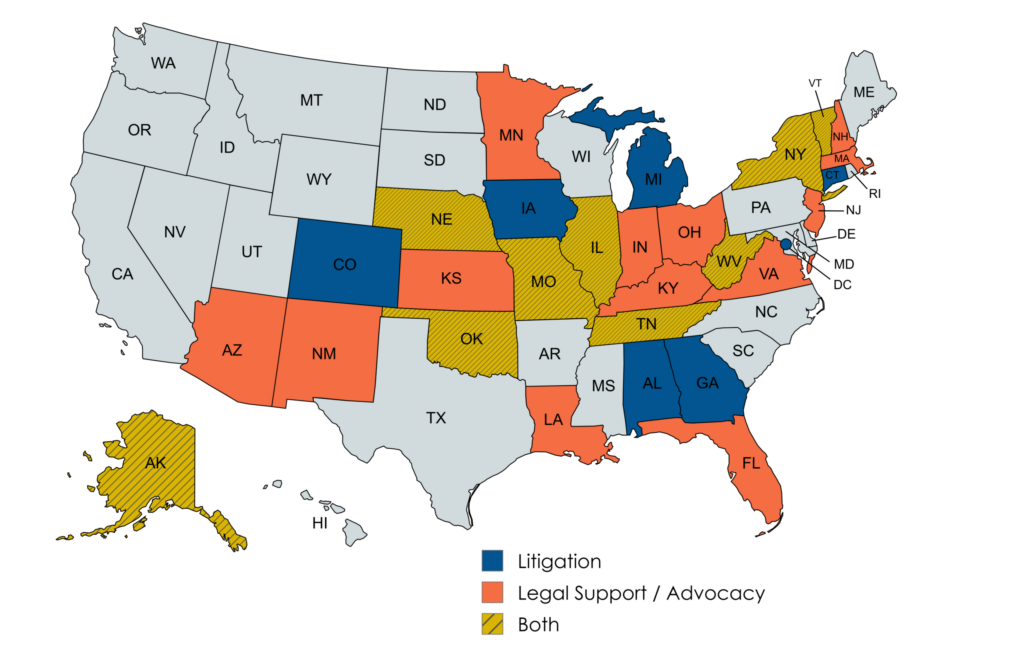
The scope of our work is nationwide. Here are highlights of our recent victories and ongoing legal advocacy across the country:
Alabama
In 2025, NCLEJ achieved a significant settlement in our lawsuit against the City of Montgomery over their operation of a modern-day debtor’s prison, which was used disproportionately by law enforcement to target and detain low-income drivers of color for traffic violations. Those who could not pay immediately were placed on “probation” with Judicial Correction Services, a for-profit private company that charged extortionate fees, forcing detainees into a punitive cycle of debt and imprisonment.
Alaska
For several years, low-income Alaskans have been unlawfully denied SNAP benefits due to the State’s backlog of SNAP applications and recertifications, consistent understaffing, and their overloaded call center. In January 2025, we won a preliminary injunction requiring the State to process SNAP applications and recertifications within legal timeframes, and as of September 2025, average SNAP delays went from 11 months to 47 days—a marked improvement thanks to our legal intervention. Unfortunately, in May 2026, the court dismissed our claims and vacated the injunction, citing a recent, harmful Supreme Court decision that restricts access to the courts for federal benefits recipients. NCLEJ has filed a notice of appeal to challenge the Alaska court’s misguided decision.
Florida
NCLEJ has partnered with the Coalition of Immokalee Workers to expand adoption of the award-winning Worker-Driven Social Responsibility model to protect human rights in global supply chains. Our innovative relationship is among the first of its kind in which a nonprofit law office serves as the legal support arm for a grassroots worker advocacy group. NCLEJ houses legal staff dedicated to advancing CIW’s mission to improve the wages and working conditions of farmworkers and provides crucial support to CIW’s campaigns to bring more participating buyers into their innovative program and maintain existing relationships with buyers.
Georgia
Following the federal District Court’s August 2015 approval of the parties’ settlement agreement mandating the State’s compliance with Food Stamp Act requirements to timely process applications and issue benefits to eligible households, NCLEJ began monitoring compliance, including the State’s issuance of $22 million in retroactive benefits to some 48,000 households. We continue to work with the State to ensure that Georgians receive the support they need in a timely and consistent manner.
Illinois
In May 2026, we reached a settlement with a private reentry housing provider in our lawsuit against the Illinois Department of Corrections (IDOC), and other private defendants to secure critical disability accommodations for a disabled individual, Mark Davenport, on Mandatory Supervised Release (MSR), a.k.a. parole. The lawsuit was first filed in November 2025. Because IDOC failed to accommodate Mr. Davenport’s physical disabilities when he was in the community, he was unnecessarily and illegally sent back to prison for four months. Despite its legal obligations, IDOC often fails to provide even the most basic disability accommodations to people on MSR. Those failures lead to people being sent back to prison when they would otherwise remain in the community with their family and friends. Litigation remains ongoing.
Michigan
In January 2025, NCLEJ received court approval of a major settlement in Waskul v. Washtenaw County Community Mental Health, leading to more than $110 million in additional State expenditures for Michiganders living with intellectual and development disabilities, who rely on Medicaid Community Living Support. This follows a landmark ruling secured by NCLEJ in 2020 in which the Sixth Circuit Court of Appeals ruled that isolation at home constitutes violations of the “integration mandate” under the ADA.
Missouri
In November 2025, NCLEJ defended our victories in our lawsuit against the Missouri Department of Social Services over their SNAP dysfunction. Low-income Missourians are unlawfully denied access to SNAP benefits due to long call center wait times, wrongful denials of benefits, and lack of disability accommodations. We secured a court order against the Missouri DSS in May 2025 requiring the State to take remedial action to improve their SNAP program. Litigation remains ongoing.
New Jersey
In 2023, NCLEJ Executive Director Jason D. Williamson and former Executive Director Dennis Parker joined the New Jersey Institute for Social Justice’s New Jersey Reparations Council to research and bring attention to the State’s involvement in slavery and its lasting impact on the contemporary life of Black New Jerseyans. In 2025, the Council published a robust report making bold policy recommendations for reparative justice policies designed to close the persistent racial wealth gap across the state.
Oklahoma
On June 23, 2022, we filed a lawsuit to advance the First Amendment rights of racial justice protestors in Oklahoma City. Our clients are six incredible young activists who began protesting police brutality in the wake of George Floyd’s murder, only to face brutal repression. The City and County worked together to charge them with felonies and even sent the U.S. Marshals to their home to arrest them—all because our clients publicly expressed views critical of the police. Our lawsuit seeks damages and an end to the retaliatory harassment of racial justice activists.
Additionally, in Oklahoma City, we are providing legal and strategic support to DeFlockOKC, a coalition dedicated to combating a legally questionable mass surveillance and data extraction scheme. The Oklahoma City Council contracts a network of automatic license plate readers through the private technology company Flock Safety. Though the Council initially approved a surveillance network focused on photographing passing license plates through fixed-position units in 2023, the current surveillance system now has far more advanced capabilities, including: vehicle fingerprinting without a license plate; AI search integration; automatic pedestrian tracking; always-on audio; autonomous drone integration; and big-data collection. The legal status of Flock’s surveillance model is not settled and is actively being challenged in federal court across multiple lawsuits.
Tennessee
In 2020, NCLEJ filed a lawsuit challenging Tennessee’s policy and practice of unlawfully depriving both children and adults of Medicaid coverage, known in Tennessee as TennCare. A defective bureaucratic process for the redetermination of eligibility of TennCare enrollees has resulted in thousands of low-income individuals being terminated from coverage without due process, and in a manner that discriminates against persons with disabilities. Litigation remains ongoing.
Vermont
NCLEJ represented Migrant Justice, a nonprofit organization dedicated to building power within the immigrant farmworker community, in a federal lawsuit against ICE, the Department of Homeland Security (DHS), and the Vermont Department of Motor Vehicles (DMV). The lawsuit challenged the government’s efforts to target Migrant Justice leaders in retaliation for speaking out about their rights, in violation of the First Amendment, as well as the DMV’s practice of information-sharing and collaboration with ICE. In January 2020, we reached a settlement with the DMV to restrict communication and information-sharing between the DMV and federal immigration agencies. In October 2020, we reached a settlement with ICE and DHS, ending the deportation cases against our clients, granting deferred action, paying damages, and agreeing to instruct officers about their duty to respect and protect First Amendment rights.
NCLEJ also represents Migrant Justice in their Milk with Dignity campaign, a groundbreaking human rights program organized by dairy farmworkers. In October 2017, Migrant Justice and Ben & Jerry’s signed a historic agreement making Ben & Jerrys the first major dairy corporation to join the Milk with Dignity Program, which requires its supplier farms to comply with better working conditions in dairy supply chains. In October 2025, the Milk with Dignity Program expanded through a new partnership with Vermont Way Foods, whose cheese will be wholly sourced in collaboration with the program.
National
In March 2026, NCLEJ sued the USDA in federal district court in Washington D.C. over their expansion of unlawful food restriction waivers that limit the types of food that can be purchased with SNAP benefits. The lawsuit challenges food restriction waivers in Colorado, Iowa, West Virginia, Tennessee, and Nebraska. By failing to provide notice and allow public comment before approval of these waivers, the USDA violated the Administrative Procedures Act. Our clients argued that these unlawful food restriction waivers deprived SNAP recipients of access to the food they need, threatening their health and welfare, while imposing significant burdens on retailers. In June 2026, the court granted our motion for summary judgment, finding that the USDA lacked the statutory authority to implement its food restriction program. As such, the court vacated the USDA’s approval of such programs, halting implementation in all five states named in the complaint—and casting doubt on the validity of similar programs in other states across the country.
In July 2026, NCLEJ sued the US Department of Health and Human Services (HHS) for failing to respond to a Freedom of Information Act (FOIA) request seeking transparency about the Trump administration’s unprecedented restrictions on federal childcare and family assistance funding. In late December 2025 and early January 2026, HHS froze access to more than $10 billion for the Child Care and Development Fund (CCDF), Temporary Assistance for Needy Families (TANF), and Social Services Block Grant (SSBG) programs in California, Colorado, Illinois, Minnesota, and New York, and imposed new documentation and approval requirements on states nationwide. These actions jeopardize essential childcare, family assistance, and social services that enable families with low incomes to work, attend school, and meet basic needs.
In May 2025, NCLEJ sued the USDA over the Trump administration’s unlawful attempts to obtain the personal information of millions of SNAP recipients. The USDA requested “unfettered access to comprehensive data,” including records stored by private companies that process SNAP payments, with no clear explanation for how this data will be used. The USDA letter indicated that any failure to comply with the order could result in the withholding of funds to state agencies. In response to our lawsuit, the USDA paused their illegal demands in June 2025, before once again threatening states with the same unlawful request. In September 2025, we filed for summary judgment, and are awaiting a decision from the court.
Our Impact At Home
Since our founding at Columbia University at the height of the Civil Rights Era, NCLEJ has delivered justice for low-income New Yorkers. Over 40% of our casework focuses on empowering low-income communities within the state we call home, and we have deep, collaborative relationships with legal services and nonprofit advocacy groups within New York City and across the state.
Here are highlights of our recent victories and ongoing advocacy in New York:
- NCLEJ filed a motion to reargue our appeal in Andersen v. Roberts before New York’s highest court, following a misguided May 2026 court opinion in favor of the state that was inconsistent with prior jurisprudence. The issue on appeal is whether disabled New Yorkers have the same right as everyone else to receive credit for work performed as a requirement of receiving public assistance. Though a 2015 ruling held that Public Assistance recipients who are required to participate in the Work Experience Program are protected by the Fair Labor Standards Act and must receive credit for their work, New York State continues to deny such credit to people with disabilities.
- As a member of the 13th Forward Coalition’s steering committee, NCLEJ is fighting for the passage of legislation that would abolish forced prison labor in New York State; raise wages for those inside, without unfair garnishments; protect worker health and safety; and create job training programs that provide real pathways to employment post-release. Our legislative agenda for 2025-2026 included advocating for the passage of a number of related bills, including: the Prison Wage Act, which would guarantee incarcerated workers a minimum wage of half the state minimum wage; a Commissary Bill to place a cap on commissary prices; a statutory version of the No Slavery in NY Act to end slavery as punishment for a crime; the Fairness & Opportunity for Incarcerated Workers Act, which would create a Labor Board to ensure that work opportunities on the inside lead to real opportunities post-release, provide health and safety protections, and take away the preferred vendor status of Corcraft; and the Gate Money Bill to raise the amount of money that individuals receive upon release from $40 to $2,500. In June 2026, the New York State Legislature passed the Commissary Bill after six years of advocacy by the Coalition.
- In May 2026, the Court in our class action lawsuit against the City of Buffalo denied the defendants’ motion for summary judgment, paving the way for our case to go to trial. Specifically, the lawsuit challenges racially discriminatory traffic enforcement practices by the Buffalo Police Department. For at least a decade, the City of Buffalo has systematically targeted Black and Latinx neighborhoods for unjustified, aggressive traffic enforcement to capture revenue for the city budget. Though the City has ceased some of the most extreme practices in response to our advocacy, the policy and practice of ticketing for profit in communities of color remain widespread, and the Buffalo police continue to operate with no meaningful oversight.
- NCLEJ continued to pursue our lawsuit against the City of Buffalo over its failure to implement the Proactive Rental Inspections (PRI) Law intended to protect residents in rental housing from lead paint and other health and safety hazards. From 2021 to 2023, 1,262 children in the City of Buffalo were confirmed to have high levels of lead in their blood. Most children who have elevated blood lead levels live in single and double-unit rentals—the same units that are supposed to be inspected under this law. Litigation remains ongoing.
- In April 2026, NCLEJ moved to hold the Suffolk County Department of Social Services (SCDSS) in contempt of a 2022 settlement over their failure to provide reasonable accommodations to persons with disabilities applying for public benefits, including SNAP, Medicaid, and emergency shelter services. The SCDSS has demonstrated systemic failure to comply with the terms of the 2022 settlement. Between January and October 2025, SCDSS failed to provide reasonable accommodations for disabled individuals requesting public benefits at a monthly noncompliance rate between 29-71%.
- In January 2026, we secured a court order against the New York State Department of Labor (NYSDOL) to reopen wage claims for hundreds of 24-hour homecare workers who were forced to work 24-hour shifts for only 13 hours of pay, in what amounts to all out wage-theft. This decision was affirmed by the Appellate Division of the Supreme Court of the State of New York in June 2026. This is part of a multi-year effort to secure justice for NYC homecare workers, all of whom are low-income immigrant women of color. In October 2024, we filed a lawsuit against GreatCare Inc., CenterLight Health System Inc., and multiple managed long-term care plans (MLTCs) under contract with the New York State Department of Health (NYSDOH) for unlawfully underpaying homecare workers.
- In January 2026, NCLEJ won a court order requiring the Office of Temporary and Disability Assistance to hold administrative fair hearings for recipients of SNAP and TA benefits receiving adverse decisions within legally-mandated timeframes, issue notices and materials advising affected people of their rights, and limit collection of clawback payments beyond the legal fair hearing resolution period. The ruling found that the OTDA violated mandatory time periods to hold administrative fair hearings and unconstitutionally deprived public benefits recipients of due process. Litigation remains ongoing.
- NCLEJ continues to enforce the groundbreaking 2014 settlement in Baez v. NYCHA, which obligates the New York City Housing Authority to ensure timely and effective remediation of toxic mold and moisture in public housing. The Baez consent decree, also the first of its kind in the nation, sets out detailed protocols mandating abatement of these deplorable living conditions, under the oversight of a court-appointed Special Master, along with mold and data analyst experts, as a reasonable accommodation to public housing tenants’ respiratory disabilities under the ADA.
- In June 2025, NCLEJ reached a favorable settlement in ourTitle VII complaint against Apple Metro, the NYC-area Applebee’s franchisee, which exposed retaliation towards a worker who organized against discriminatory wages. Apple Metro paid the full minimum wage of $15 an hour, plus tips, to predominantly non-Black and white Applebee’s workers in Midtown, while paying only the subminimum wage of $10 an hour to predominantly Black and Brown employees working at the South Bronx Applebee’s location. Following our legal challenge to their racially-discriminatory pay structure, Apple-Metro subsequently fired our client from his position at Applebee’s in the South Bronx. In response, we amended our legal complaint to include a retaliatory firing charge. Under the settlement, Apple-Metro must notify former workers of their organizing rights under federal law. This victory is a powerful affirmation that retaliation against workers who speak out against workplace injustice will not stand.
Our Community Partners
NCLEJ proudly partners with community organizations on the ground to advance our mission. We understand that the fight for economic, racial, and disability justice is not dictated by strategies created at a distance, but in collaboration with the local communities most affected by the problems we seek to address. Collaborating with local and community-led organizations improves our ability to provide practical and direct legal assistance, as well as expands our geographic reach. In return, we boost the capacity of our partners to achieve their goals
In recent years, we’ve partnered with many local organizations across the nation, including:
- A Little Piece of Light
- Abolish Slavery National Network
- ACLU Foundation of Vermont
- ACLU of Oklahoma
- Alabama Appleseed
- Alaska Legal Services
- American Civil Liberties Union
- Asian American Legal Defense Fund
- Atlanta Legal Aid Society
- Black Lives Matter-Oklahoma
- Black Love Resists in the Rust
- Brownsville Green Justice
- Building with Dignity and Respect Standards Council
- Center for Children’s Advocacy
- Center for Constitutional Rights
- Center for Economic Justice
- Center on Budget and Policy Priorities
- Centro de Trabajadores Unidos en la Lucha
- Chinese Staff and Workers’ Association
- Citizen Action
- Coalition of Immokalee Workers
- Color of Change
- Consumer Federation of America
- Consumer Reports
- Disability Rights Louisiana
- Disability Rights Michigan
- Don Bosco Workers Inc.
- Empire Justice Center
- Empower Missouri
- Environmental Advocates NY
- Fair Food Standards Council
- Flushing Workers Center
- Focus on Labor Exploitation
- Foundation for Liberating Minds
- Frack Outta Bk
- Georgia Legal Services Program
- Indigenous Kinship Collective
- International Trade Workers Federation
- Kentucky Equal Justice Center
- Laundry Workers Centers
- Legal Aid of Society of Eastern Virginia
- Legal Aid of Southeast and Central Ohio
- Legal Aid Society of Cleveland
- Legal Services of Central New York
- Legal Services of Eastern Missouri
- Make the Road NY
- Manhattan Together
- Mi Casa Resiste
- Migrant Justice
- Milk with Dignity Standards Council
- Mobilization for Justice
- NAACP Legal Defense and Educational Fund, Inc.
- NAACP of Oklahoma
- National Consumer Law Center
- National Employment Law Project
- National Employment Lawyers Association – NY
- National Health Law Program
- National Health Law Project
- National Immigration Law Center
- National Legal Aid and Defender Association
- National Mobilization Against Sweatshops
- Neighborhood Legal Services
- New Economy Project
- New Jersey Institute for Social Justice
- New York Legal Assistance Group
- Northern Justice Project
- Northern Manhattan Improvement Corporation
- NYCLU
- Ocean Hill-Brownsville Coalition of Young Professionals
- One Fair Wage
- People’s Council
- Public Utilities Law Project
- SC Appleseed
- Shriver Center on Poverty Law
- South Bronx Churches Sponsoring Committee, Inc.
- Southern Poverty Law Center
- Tennessee Justice Center
- The Action Lab
- The Legal Aid Society
- Washtenaw Association for Community Advocacy
- Western New York Law Center